PLC President Praises Multinational Maritime Coalition and Saudi Support for Yemeni State Institutions and Regional Security
Riyadh
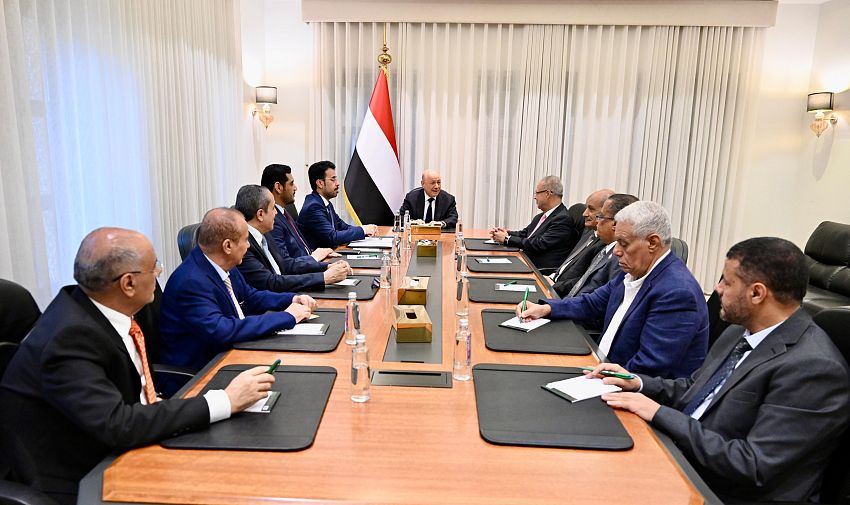
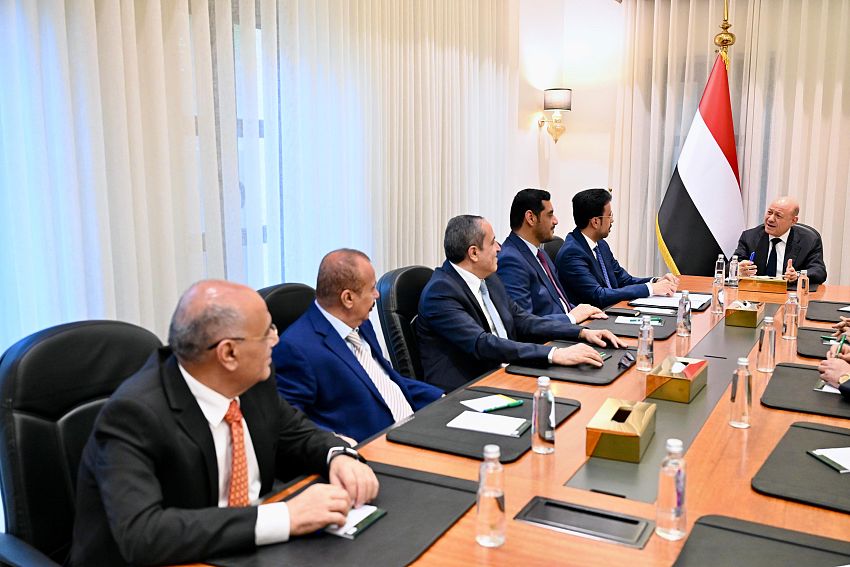
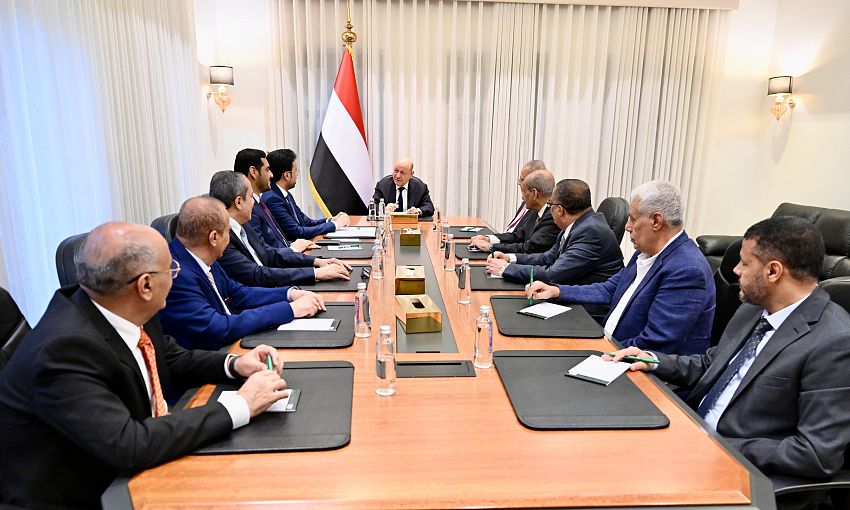
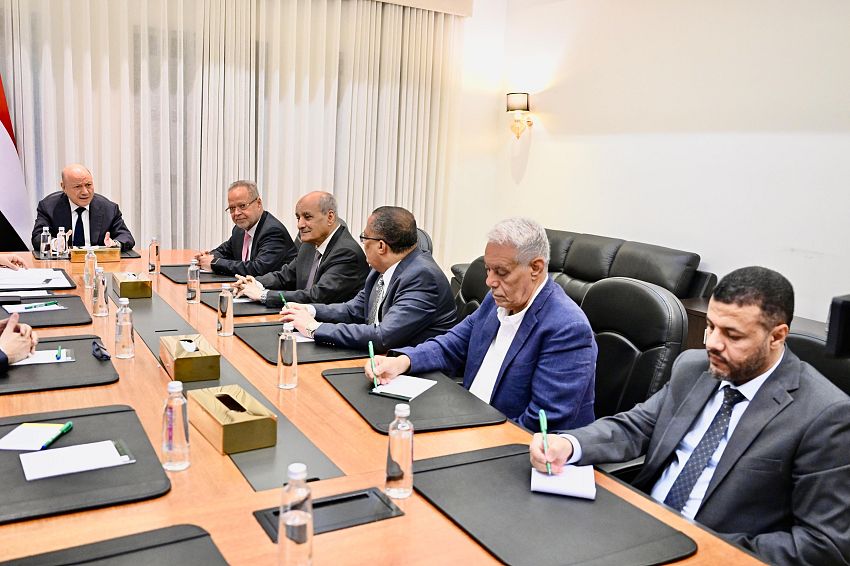
His Excellency President Dr. Rashad Mohammed Al-Alimi, President of the Presidential Leadership Council (PLC), met with Mohammed Al-Ghaithi, Chairman of the Consultation and Reconciliation Commission, his deputies Abdulmalik Al-Mikhlafi, Sakhr Al-Wajeeh, and Akram Al-Ameri. His Excellency also met with the secretaries-general of the political parties and political components represented in the Commission.
The meeting reviewed the latest domestic and regional developments. Discussions centered on the escalation by the Iran-backed Houthi terrorist militias and their continued recklessness with the interests and resources of the Yemeni people, which has further aggravated the country’s humanitarian suffering.
President Al-Alimi renewed his appreciation for the role played by the Consultation and Reconciliation Commission as one of the principal bodies supporting the Presidential Leadership Council. He praised the Commission as an important mechanism for managing political pluralism and safeguarding the existing partnership among the national forces opposed to the Houthi militias’ project.
The President stressed that the country was passing through a pivotal stage in its history that required the highest degree of responsibility. He noted that recent developments had demonstrated that the Houthi militias continued to rely on escalation to secure illegitimate gains and that their decisions were becoming increasingly dictated by external agendas unrelated to the interests of the Yemeni people.
President Al-Alimi briefed the meeting on the measures taken by the government in responding responsibly to the Houthi escalation while safeguarding Yemen’s sovereignty. He affirmed that the government’s message had been clear and firm in rejecting coercion and blackmail as a means of imposing a fait accompli.
The President praised the pioneering and constructive role played by the Kingdom of Saudi Arabia under the leadership of the Custodian of the Two Holy Mosques, King Salman bin Abdulaziz Al Saud, and His Royal Highness Crown Prince Mohammed bin Salman bin Abdulaziz. He said the Kingdom’s stances had constituted a fundamental pillar in preserving the cohesion of Yemen’s state institutions, supporting the national economy, alleviating humanitarian suffering, and promoting security and stability in Yemen and the wider region. He added, these stances reflected the growing strategic partnership between the two brotherly countries and peoples.
President Al-Alimi also welcomed the announcement of the establishment of the multinational defensive maritime coalition led by the Kingdom of Saudi Arabia. He described the strategic initiative as a highly significant step toward strengthening collective security, protecting freedom of international navigation, and securing the vital maritime corridors in the Red Sea, the Gulf of Aden, and the Bab Al-Mandab Strait.
His Excellency affirmed that the Saudi-led maritime coalition reflected growing international recognition that the security of maritime routes was a shared responsibility that could not be neglected. He added that its success would contribute to consolidating regional stability, upholding the rules of international law, and safeguarding the common interests of peoples around the world.
The President urged all Yemeni political forces to capitalize on these developments by strengthening unity, working collectively to reinforce the domestic front, and rallying behind the state-building project. He stressed that the battle to liberate Yemen is not the responsibility of the Armed Forces alone, but of the Republic as a whole.
He further stressed that the current stage required political parties and national components to reclaim their natural role as forces for public awareness, mobilization, and national engagement. He said they had a responsibility to confront existing threats, restore the primacy of the national state, and further isolate the militias and their destructive project.
President Al-Alimi also emphasized that the mission of political parties today was to make the battle to restore state institutions a cause embraced by society as a whole, rather than merely a concern of the authority. He expressed his aspiration for the Consultation and Reconciliation Commission to evolve into a more effective national platform for promoting consensus and broad national alignment.
The President concluded by affirming that Yemenis have become more aware than ever that their real battle is against the project that has usurped the state, impoverished the people, destroyed the country’s national resources, and tied Yemen’s future to destabilizing transnational agendas.

PLC President Calls for General Mobilization, Opens Door for Safe Return of Those Misled by Houthis
President Dr. Rashad Al-Alimi, President of the Presidential Leadership Council (PLC), called on the Yemeni people to engage in general mobilization

President Al-Alimi Holds Phone Call with President Abdel Fattah Al-Sisi
Fri ، 25 Sep 2026 03:24

PLC President: Armed Forces Capable of Regaining Initiative and Ending Houthi Threat
Thu ، 24 Sep 2026 03:24

President Al-Alimi Receives Reply Letter from Emir of Kuwait
Tue ، 22 Sep 2026 03:24