PLC President Urges Political Parties to Strengthen National Awareness and Internal Unity in Support of State Project
Riyadh
His Excellency President Dr. Rashad Al-Alimi, President of the Presidential Leadership Council, affirmed that the current phase requires the highest levels of national cohesion to confront the Iranian project and its destabilizing proxies in Yemen and the region. He called on political parties and national blocs to play a more active role by leading public awareness efforts and reinforcing the internal front beyond the scope of traditional political activity.
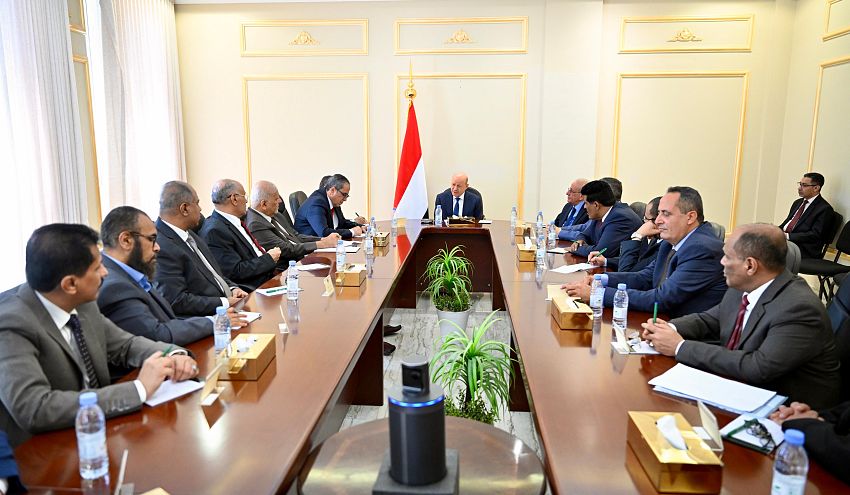
Speaking during a meeting today, Thursday, with leaders of the National Coalition of Political Parties and Components, headed by Chairman of the Shura Council Dr. Ahmed Obeid bin Dagher, Al-Alimi said political parties constitute the state’s political backbone and that their role in shaping public opinion is no less important than the military battle. He described them as essential partners in defending the republican system and safeguarding its national achievements.
He urged political parties and all national forces to strengthen public support for the state project, back the armed forces, support government reforms, and reinforce confidence in national institutions. He also stressed the need to avoid rhetoric that could undermine the republican ranks and to mobilize all national efforts against the Iranian project and its proxies.
The President briefed the coalition leaders on recent Houthi escalation, highlighting the blatant Iranian violation of Yemen’s sovereignty through the dispatch of an aircraft belonging to the Islamic Revolutionary Guard Corps (IRGC) to Sanaa Airport, which is under Houthi control. He said the aircraft carried military experts and dual-use technologies, describing the move as a clear violation of UN Security Council resolutions and Yemen’s sovereignty.
Al-Alimi said the incident, together with military escalation across multiple fronts, attacks on international shipping, assassinations, and continued violations, demonstrates that the Houthis have never been genuine partners for peace but instead represent an existential threat.
He reiterated that the Yemeni state had consistently warned that any regional understandings failing to address the root cause—the Iranian project—would not produce lasting peace. He argued that the project is based on exporting crises and exploiting conflicts rather than resolving them.
The President said recent regional developments and renewed Iranian attacks against countries in the region validate Yemen’s long-standing assessment that leniency toward Iran and its armed proxies would not contain the threat. Instead, he said, such approaches only allow them to portray these understandings as victories despite the destruction and suffering on the ground.
He described the current regional developments as an important turning point that should be leveraged politically, diplomatically, and nationally to strengthen the Yemeni state’s position, build momentum toward ending the Houthi coup, and restore state institutions.
Al-Alimi also updated political party leaders on contacts and diplomatic efforts undertaken recently by the state leadership and the government at the internal, regional and international levels in response to the latest Iranian violation. He said these efforts had succeeded in presenting a unified national narrative to the international community, emphasizing that the situation in Yemen is not merely an internal conflict but a direct extension of Iranian interference in Yemen and the wider region.
The President reviewed the government’s comprehensive financial, administrative, and institutional reform efforts, noting that tangible progress had been achieved despite difficult economic conditions. He pointed to improved public revenues, saying they reinforce the government’s strategy of self-reliance and transform the disruption of oil exports caused by Houthi attacks into an opportunity to expand domestic revenue sources.
His Excellency also cited progress in strengthening oversight and transparency, reforming the public procurement system, and addressing humanitarian and service-related issues, particularly support for wounded personnel. He added that the government has also improved public spending efficiency and restored the confidence of regional and international partners.
President Al-Alimi said Houthi attacks on oil facilities were intended to paralyze the state economically and trigger a comprehensive humanitarian crisis. However, he said generous support from Saudi Arabia, coupled with the government’s reform program, had foiled that strategy and demonstrated that building an economy based on domestic resources remains the country’s strategic path, even after oil exports resume.
The President renewed his appreciation for Saudi Arabia’s support for the government and its economic and financial reform agenda, saying the Kingdom’s assistance has contributed to economic stability and the continued functioning of state institutions. He described the strategic partnership with Saudi Arabia as a key pillar for achieving a secure future for Yemen and the region.
He also urged political parties to expand their engagement with citizens, maintain direct communication with their constituencies, explain ongoing political and military developments, and counter Houthi disinformation campaigns. He said the coming period requires parties to move beyond observation to active initiative and influence, including through stronger public outreach and social media engagement.
Al-Alimi reaffirmed the state’s commitment to peace but stressed that peace cannot come at the expense of Yemen’s sovereignty, dignity, security, stability, or the future of its people.
He added that if the Houthis continue their escalation and reject their obligations, the state will continue taking all necessary measures to protect the interests of the Yemeni people and restore state institutions. He said these efforts would rely on national unity and determination to end the isolation endured by millions of Yemenis living in Houthi-controlled areas.
For their part, leaders of the political parties and national components affirmed that restoring state institutions remains the common cause uniting all national forces. They reiterated their support for the Presidential Leadership Council and the government and pledged to back efforts aimed at strengthening state institutions, advancing economic and administrative reforms, consolidating security and stability in liberated governorates, and building a model state that meets the aspirations of all Yemenis.
The party leaders also praised the political and diplomatic efforts led by the state leadership in confronting Iranian interference and Houthi violations. They stressed that national unity, public support for state institutions, and backing for the armed forces and security agencies constitute the first line of defense against the Iran-backed Houthi project and are essential for protecting Yemen’s national identity and republican system.
The meeting was attended by Dr. Yahya Al-Shaibi, Director of the Presidency Office.

PLC President Calls for General Mobilization, Opens Door for Safe Return of Those Misled by Houthis
President Dr. Rashad Al-Alimi, President of the Presidential Leadership Council (PLC), called on the Yemeni people to engage in general mobilization

President Al-Alimi Holds Phone Call with President Abdel Fattah Al-Sisi
Fri ، 25 Sep 2026 03:24

PLC President: Armed Forces Capable of Regaining Initiative and Ending Houthi Threat
Thu ، 24 Sep 2026 03:24

President Al-Alimi Receives Reply Letter from Emir of Kuwait
Tue ، 22 Sep 2026 03:24