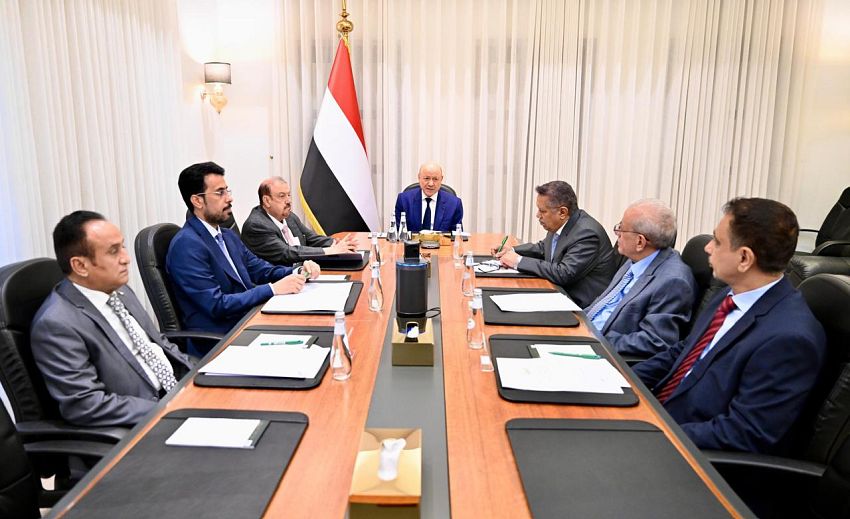
President Al-Alimi: State Moving Ahead with Reform Agenda and Firm Deterrence Against Houthi Escalation
Riyadh
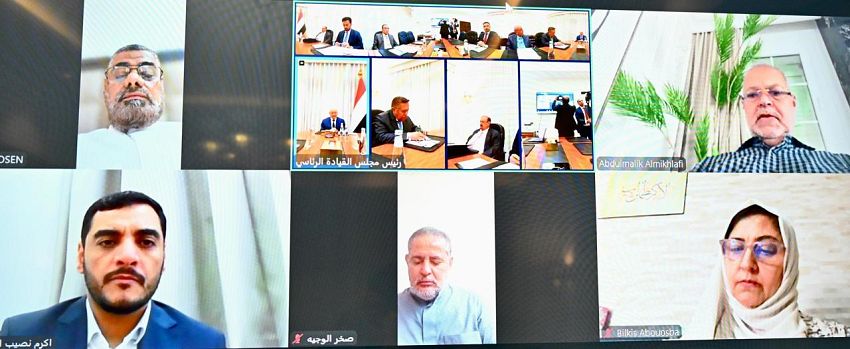
His Excellency President Dr. Rashad Al-Alimi, President of the Presidential Leadership Council, chaired a joint meeting on Wednesday with the leadership of the House of Representatives, the Shura Council, and the Consultation and Reconciliation Commission. The meeting was attended by House Speaker Sheikh Sultan Al-Barakani, Shura Council Chairman Dr. Ahmed bin Dagher, and Consultation and Reconciliation Commission Chairman Mohammed Al-Ghaithi.
The meeting reviewed the latest national developments, particularly the renewed escalation by the Houthi militias, backed by the Iranian regime. It included violations of Yemen’s sovereignty, most notably the operation of an Iranian Revolutionary Guard aircraft to Sana’a International Airport in a flagrant challenge to UN Security Council resolutions and the UN sanctions system.
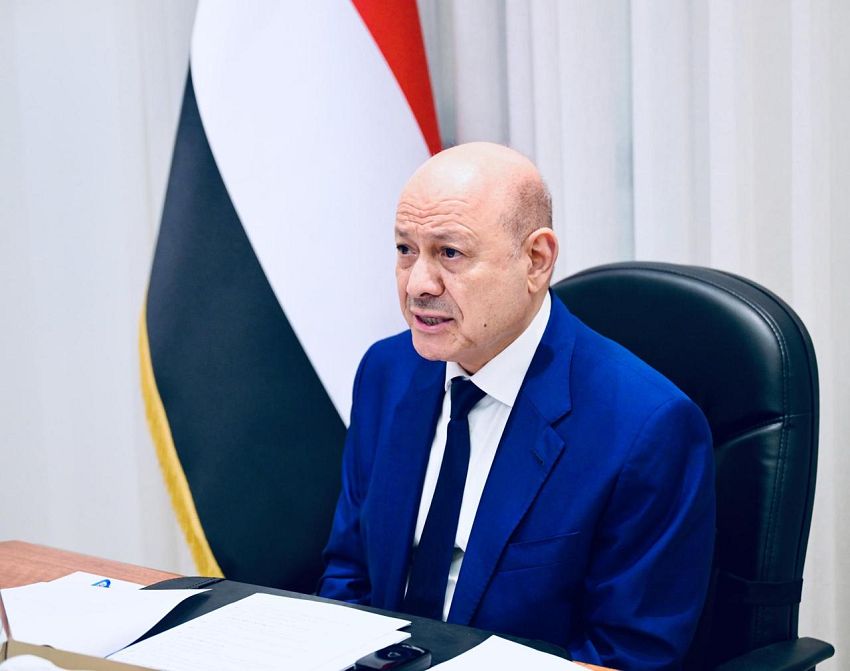
During the meeting President Al-Alimi expressed his appreciation for the role played by the legislative and consultative institutions during the current critical stage, which, he said, requires the highest levels of national unity and a unified position and message. He stressed that safeguarding the state is a collective responsibility shared by all institutions under the Constitution and the law.
The President briefed the participants on the contacts and measures taken by the state leadership to deter the escalation at all levels, mobilize domestic and international support in defense of the state’s legal status, and counter Houthi misinformation regarding the purported humanitarian nature of the Iranian flight. He said preliminary information indicated that the aircraft was used to transport personnel, experts, and technologies with military and security applications aimed at strengthening the military capabilities of the terrorist Houthi militias.
His Excellency said the aircraft represented only one aspect of the escalation, which also includes continued mobilization and recruitment, the smuggling of weapons and military technologies, infiltration attempts along several fronts—particularly the West Coast front—and ongoing military build-up toward Marib and other areas. He noted that these activities had been met with a firm response by the armed forces across multiple axes.
President Al-Alimi also referred to the state’s rapidly improving capabilities to monitor and counter Houthi activities. He said this includes tracking the group’s cooperation with the terrorist organizations Al-Qaeda and ISIS, the training of criminal elements, and the establishment of clandestine terrorist networks and cells. He added that these cells were intended to carry out assassinations, surveillance, and sabotage operations in the liberated governorates.
In this context, the President praised the security and intelligence services for their significant successes in uncovering these cells and thwarting many of their criminal plots. He added that the preliminary findings of the investigations would be announced soon.
The President reiterated that the current battle is not solely a military one but also a battle of awareness, law, and diplomacy. He highlighted the important role of the legislative and consultative institutions in supporting national unity, exposing Houthi violations, preparing national policy proposals, and unifying political and media messaging. He also underscored their role in engaging with national elites and societal forces, and in presenting initiatives that strengthen national cohesion and counter misinformation.
He said the greatest challenge posed by the state’s adversaries lies not in their military strength but in their failed attempts to undermine national unity and weaken citizens’ confidence in their state and legitimate institutions.
“Our collective responsibility today is to demonstrate that the state operates as one team and that all its institutions stand in the same trench in defense of the republic, its sovereignty, and the security of its citizens,” the President added.
His excellency noted that building a successful state model, maintaining unity of purpose, strengthening the home front, and rallying public opinion around the state project are no less important than achievements on the battlefield. Modern wars, he noted, are won not only on the frontlines but also through unity of will, resilient state institutions, confidence in achieving decisive victory with God’s help, and by ignoring defeated and misleading platforms.
Addressing the government’s reform agenda and the implementation of the Presidential Leadership Council’s decisions and recommendations, President Al-Alimi said the reform program had recently moved from the planning stage to practical implementation. He said progress had been made particularly in financial and administrative reforms, governance enhancement, revenue management, and digital transformation. These measures, he added, would help build more efficient state institutions capable of delivering better services to citizens.
He said the government and the Central Bank, with steadfast support from Saudi Arabia, had succeeded in preserving monetary stability and made significant progress in restoring fiscal discipline. He noted that the government had closed state accounts held outside the Central Bank and completed the electronic linkage between the Central Bank and its branch in Marib. He added that revenue oversight had been strengthened, revenue-generating institutions reassessed, and several economic councils and authorities reactivated. The government had also reviewed the status of economic institutions, oil companies, and the banking sector, while enhancing coordination between ministries and local authorities. These measures, he said, would reinforce good governance and strengthen the confidence of citizens as well as regional and international partners in state institutions.
The President reaffirmed the commitment of the Presidential Leadership Council and the government to pressing ahead with ambitious plans to improve basic services, particularly in the electricity sector. He said the plans also include securing fuel supplies for power generation plants, regulating the operation of ports and border crossings, combating smuggling, and improving the economic environment. He stressed that these efforts would continue despite limited resources and the pressures resulting from Houthi attacks on oil facilities.
He stressed that these reforms constitute an integral part of the battle to restore state institutions. He stated that “a strong state is built on effective institutions, sound governance, and a resilient economy, alongside protecting the country and defending its sovereignty—not through reproducing wars, crises, superstition, and destruction.”
President Al-Alimi also commended the steadfast support provided by Saudi Arabia, under the leadership of the Custodian of the Two Holy Mosques King Salman bin Abdulaziz Al Saud and Crown Prince and Prime Minister Prince Mohammed bin Salman bin Abdulaziz Al Saud, for Yemen’s recovery plans and economic and financial reform programs. He said the support reflects the depth of the strategic partnership between the two countries and Saudi Arabia’s commitment to strengthening Yemeni state institutions and enhancing their ability to meet their essential obligations toward citizens.
He further praised Saudi Arabia’s leading role in supporting all initiatives aimed at achieving a comprehensive and just peace in Yemen, based on nationally, regionally, and internationally agreed references, in a manner that fulfills the Yemeni people’s legitimate aspirations for security, stability, and development.
For their part, the heads and deputy heads of the House of Representatives, the Shura Council, and the Consultation and Reconciliation Commission affirmed their institutions’ full support for the Presidential Leadership Council and the government in all measures and decisions aimed at protecting national sovereignty, strengthening the home front, and confronting the Iranian-backed Houthi escalation. They stressed the importance of unifying the national discourse, supporting the armed forces and security agencies, and backing diplomatic efforts to mobilize a firmer international response to Houthi violations.
The participants also commended the government’s progress in implementing its economic and administrative reform program and praised the security and intelligence services for uncovering and foiling terrorist plots and sabotage cells. They described these achievements as reinforcing public confidence in state institutions and demonstrating their ability to uphold the rule of law.
The participants called on all national forces to rally behind the state project, unite ranks in support of the battle for liberation, and work toward ending the coup and the humanitarian suffering caused by the terrorist Houthi militias.
The meeting was attended by Dr. Yahya Al-Shuaibi, Director of the Office of the Presidency, Mohsen Basurah, Deputy Speaker of the House of Representatives, Abdullah Abu Al-Ghaith and Wahi Aman, Deputy Chairmen of the Shura Council, and Abdulmalik Al-Mikhlafi, Sakhr Al-Wajeeh, Akram Al-Ameri, and Balqees Abu Osba, Deputy Chairpersons of the Consultation and Reconciliation Commission.

PLC President Calls for General Mobilization, Opens Door for Safe Return of Those Misled by Houthis
President Dr. Rashad Al-Alimi, President of the Presidential Leadership Council (PLC), called on the Yemeni people to engage in general mobilization

President Al-Alimi Holds Phone Call with President Abdel Fattah Al-Sisi
Fri ، 25 Sep 2026 03:24

PLC President: Armed Forces Capable of Regaining Initiative and Ending Houthi Threat
Thu ، 24 Sep 2026 03:24

President Al-Alimi Receives Reply Letter from Emir of Kuwait
Tue ، 22 Sep 2026 03:24