PLC President: No Sustainable Peace Without Disarming Militias
Riyadh
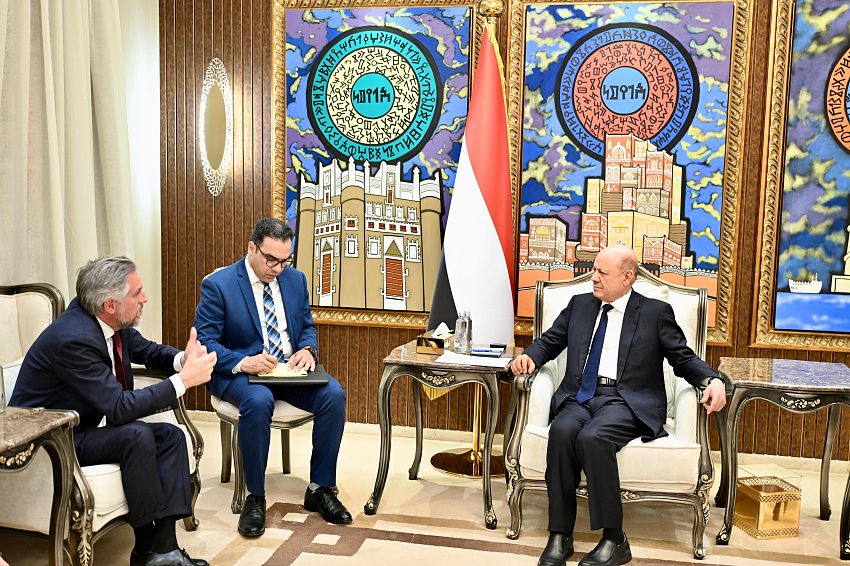
His Excellency President Dr. Rashad Al-Alimi, President of the Presidential Leadership Council, today Wednesday received European Union Ambassador Mr. Gabriel Munuera Viñals to discuss areas of bilateral cooperation and prospects for expanding the existing partnership.
The talks focused on supporting government reform efforts, increasing development financing programs, humanitarian interventions, and institutional capacity-building.
President Al-Alimi was briefed by the EU ambassador on the Union’s programs in a number of liberated governorates. He expressed his appreciation for the important role played by the European mission in supporting Yemen politically, economically, humanitarianly, and developmentally.
The meeting also reviewed the outcomes of the ambassador’s visit to the governorates of Aden and Taiz, as well as proposed interventions based on the EU’s assessment of local conditions, particularly in the water, energy, and livelihoods sectors.
The President discussed recent developments in the region and the threat posed by Iran’s proxies to the security of maritime routes and waterways. He stressed that any approach to a political settlement must address the root causes of this threat, foremost among them the disarmament of rogue militias.
He emphasized that sustainable peace cannot be achieved merely through a ceasefire, but rather through supporting and building state institutions that hold a monopoly on the use of force and exercise sovereignty across the entire national territory.
President Al-Alimi expressed hope that the current international opportunity could be leveraged to reshape the region’s security environment and keep pace with ongoing regional developments. He stressed the importance of increasing political and economic pressure on militias backed by the Iranian regime.
He urged European Union member states to join international measures aimed at designating the Houthi group, its leaders, and its financial and logistical networks, and to expand sanctions against arms-smuggling, financing, and money-laundering networks.
The President noted that the longer the international community delays addressing the source of the threat, the higher the cost of safeguarding global maritime navigation. In this regard, he said that security in the Red Sea begins on land and that strengthening the Yemeni state’s capacity to protect its coastline constitutes a direct investment in European and global security, not merely support for a friendly country.
President Al-Alimi also reviewed the government’s ongoing economic and institutional reform agenda, as well as efforts to unify military and security decision-making with the sincere support from the Kingdom of Saudi Arabia. He highlighted the challenges facing certain service sectors and the role expected from the European Union at all levels.
The President renewed his profound appreciation to the Kingdom of Saudi Arabia for its steadfast commitment to supporting Yemen, its people, and its national institutions. He also commended Saudi initiatives, most recently the fuel derivatives grant, which is expected to help alleviate citizens’ suffering and improve the sustainability of essential services, particularly electricity, reflecting the depth of the strategic partnership between the two brotherly countries.
He pointed to government plans to address the energy crisis in partnership with Saudi Arabia through the addition of new power-generation capacity, the expansion of alternative and renewable energy projects, and progress on the electricity interconnection project with the Kingdom. He described the project as a strategic initiative capable of enhancing energy security, improving the efficiency of the power system, and supporting development and economic stability.
President Al-Alimi expressed his aspiration to work with the European Union to broaden the scope of partnership, including the reactivation of the Friends of Yemen Group as an important platform for coordinating international support.
He also called for the resumption of development financing programs and building on recent initiatives by the World Bank, the International Monetary Fund, and other financial institutions to help the government rebuild and rehabilitate services and stimulate the national economy.
The meeting was attended by Dr. Yahya Al-Shuaibi, Director of the Office of the Presidency.

PLC President Calls for General Mobilization, Opens Door for Safe Return of Those Misled by Houthis
President Dr. Rashad Al-Alimi, President of the Presidential Leadership Council (PLC), called on the Yemeni people to engage in general mobilization

President Al-Alimi Holds Phone Call with President Abdel Fattah Al-Sisi
Fri ، 25 Sep 2026 03:24

PLC President: Armed Forces Capable of Regaining Initiative and Ending Houthi Threat
Thu ، 24 Sep 2026 03:24

President Al-Alimi Receives Reply Letter from Emir of Kuwait
Tue ، 22 Sep 2026 03:24