President Al-Alimi: Peace in Yemen Begins with Dismantling Iranian Regime’s Project and Restoring State Institutions
Riyadh
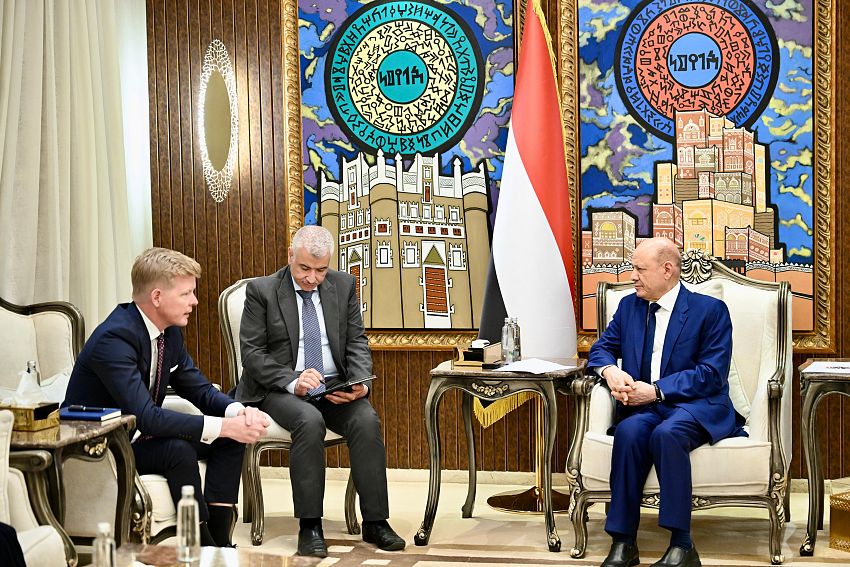
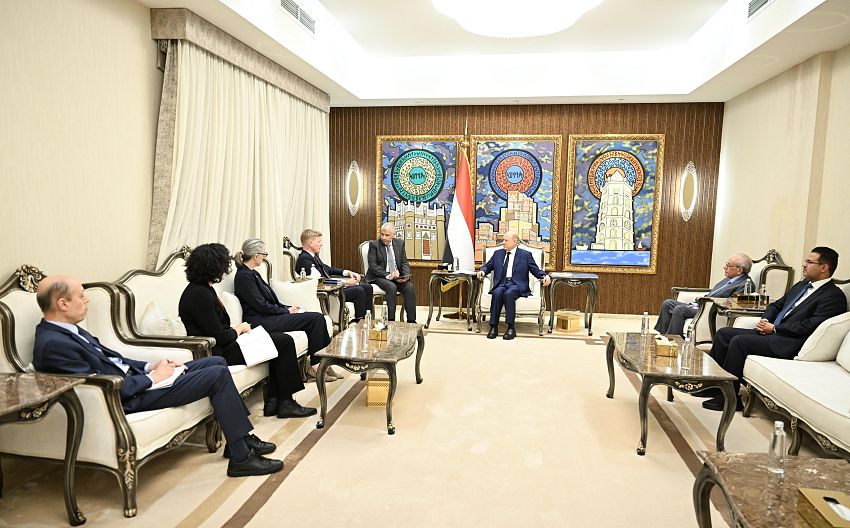
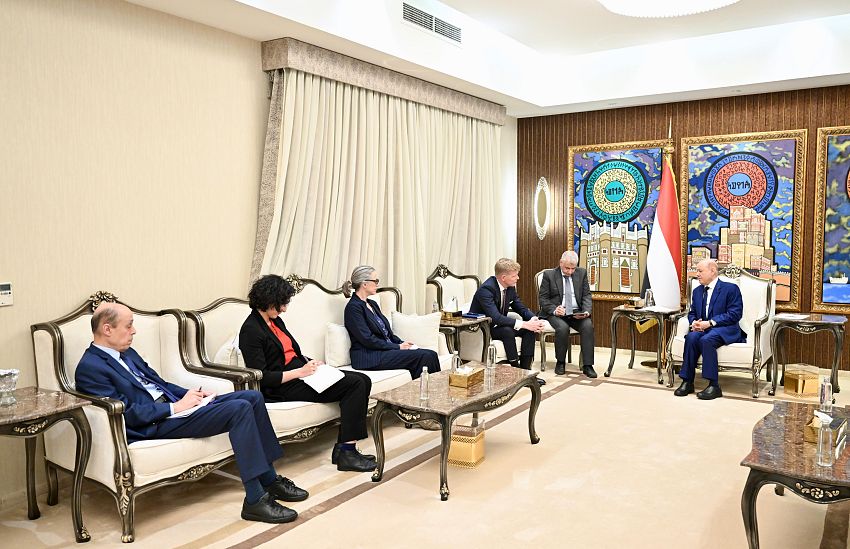
President Dr. Rashad Al-Alimi, President of the Presidential Leadership Council, received on Tuesday Mr. Hans Grundberg, the United Nations Special Envoy for Yemen.
At the outset of the meeting, the UN envoy conveyed his sincere condolences to the President on the passing of former Yemeni President Abd-Rabbu Mansour Hadi, wishing Yemen and its people security, stability, and peace.
President Al-Alimi was briefed by the UN envoy on the outcomes of his recent consultations, particularly efforts to complete the implementation of the agreement recently reached for the release of 1,750 detainees. His Excellency also received an update on coordinated international efforts to revive the peace process in line with its agreed references, which were overturned by the Iran-backed Houthi terrorist militias.
The President renewed his appreciation for the efforts of the UN envoy’s office and all regional and international partners, foremost among them the Kingdom of Saudi Arabia, the Sultanate of Oman, and the International Committee of the Red Cross, in securing the detainee release agreement. He described the deal as an important humanitarian step that restores hope to thousands of Yemeni families. He expressed his hope that the achievement would be built upon and not undermined by delays or obstruction from the Houthi militias.
President Al-Alimi also discussed recent regional developments, particularly the Houthis’ declared involvement in defending the Iranian regime and its affiliated militias across the region. He said the announcement further confirmed the group’s subordination to Tehran’s destabilizing agenda, including the use of Yemen as a platform to serve suspicious objectives unrelated to the interests of the Yemeni people.
The President stressed the importance of the international community recognizing that Yemen’s crisis is not a dispute between political parties. But rather a conflict with an armed group that challenges the state’s exclusive authority and is linked to a transnational regional project directed by an operations room affiliated with Iran’s Islamic Revolutionary Guard Corps.
He reaffirmed the Presidential Leadership Council and government’s commitment to achieving sustainable peace based on the agreed references, particularly UN Security Council Resolution 2216. He said the resolution addresses the root causes of the conflict, rather than merely establishing a truce that could lead to a more complex recurrence of the crisis.
President Al-Alimi emphasized that lasting peace cannot be achieved through power-sharing between the state and a militia. Rather it is achieved through restoring the exclusive authority of national institutions, upholding the rule of law, delivering justice, and protecting rights and freedoms.
He noted that while the Iranian regime speaks of de-escalation, its militias in Yemen continue arbitrary arrests, enforced disappearances, recruitment campaigns, and violations of public freedoms, in addition to assassinations, the elimination of opponents, property confiscation, and the suppression of civil society. He said such violations must remain a central component of UN reporting, as they constitute some of the most significant obstacles to peace in Yemen and the wider region.
The President also reviewed domestic developments and the government’s efforts to normalize conditions, address current challenges, and advance a comprehensive program of financial, administrative, and institutional reforms.
He expressed hope for a more active UN role in mobilizing international support for the reform agenda, safeguarding the core references of a comprehensive political settlement, and preventing humanitarian understandings from being transformed into political or military gains. He further stressed the need to address the growing linkage between the Yemeni file and regional developments as a key factor in any future peace approach.
President Al-Alimi warned that every day the restoration of state institutions is delayed increases the risk of Yemen becoming a permanent platform for regional conflicts and a threat to international navigation and collective security. He called for greater clarity in defining the nature of the problem, stronger measures to address its root causes, and sustained support for the Yemeni state as the sole guarantor of security and stability.

PLC President Calls for General Mobilization, Opens Door for Safe Return of Those Misled by Houthis
President Dr. Rashad Al-Alimi, President of the Presidential Leadership Council (PLC), called on the Yemeni people to engage in general mobilization

President Al-Alimi Holds Phone Call with President Abdel Fattah Al-Sisi
Fri ، 25 Sep 2026 03:24

PLC President: Armed Forces Capable of Regaining Initiative and Ending Houthi Threat
Thu ، 24 Sep 2026 03:24

President Al-Alimi Receives Reply Letter from Emir of Kuwait
Tue ، 22 Sep 2026 03:24